Quotation vs Estimate vs Invoice: What's the Difference?
Introduction
If you've ever prepared a quotation for a customer or sent an invoice after completing a project, you've probably come across the terms quotation, estimate, and invoice. While many business owners use these documents interchangeably, they actually serve very different purposes.
Using the wrong document at the wrong stage of a sale can create confusion, delay payments, and even affect customer trust.
For example, imagine a customer asks for pricing to renovate an office. If you send an invoice before the customer approves the work, they may assume you've already charged them. On the other hand, if you send only an estimate after they've confirmed the order, there may be disagreements later because estimates are usually approximate, not final.
Whether you run a construction company, retail store, manufacturing business, consultancy, or service agency, understanding the difference between quotations, estimates, and invoices helps you communicate professionally and keep your sales process organized.
In this guide, we'll explain what each document means, when to use it, and how modern business software can simplify the entire workflow.
What Is a Quotation?
A quotation is a formal document that provides the exact price for products or services requested by a customer. It is usually prepared after you understand the customer's requirements and are ready to offer a fixed price.
A quotation typically includes:
- Company details
- Customer details
- Quotation number
- Date
- Product or service description
- Quantity
- Unit price
- GST details
- Total amount
- Payment terms
- Delivery timeline
- Validity period
- Terms and conditions
Once accepted by the customer, a quotation often becomes the basis for the final order.
Best used when: The scope of work and pricing are clearly defined.
What Is an Estimate?
An estimate is an approximate cost provided before all project details are finalized.
Unlike a quotation, an estimate is flexible and may change if the project scope, material costs, or customer requirements change.
For example:
- Home renovation costs
- Construction projects
- Interior design work
- Custom furniture
- Machine installation
These projects often require estimates because the final cost depends on multiple variables.
Best used when: The exact cost cannot yet be determined.
What Is an Invoice?
An invoice is a payment document issued after goods are delivered or services are completed.
Unlike quotations and estimates, an invoice requests payment for completed work.
A typical invoice includes:
- Invoice number
- Customer information
- Products or services delivered
- GST details
- Payment due date
- Total payable amount
- Payment method
Invoices are essential for accounting, taxation, and payment tracking.
Best used when: The customer has received the products or services and payment is due.
Quotation vs Estimate vs Invoice: Key Differences
| Feature | Quotation | Estimate | Invoice |
|---|---|---|---|
| Purpose | Offer fixed pricing | Provide approximate cost | Request payment |
| Pricing | Usually fixed | Approximate | Final |
| Sent When | Before order confirmation | Early planning stage | After delivery or completion |
| Can Price Change? | Rarely | Yes | No |
| Includes GST? | Usually | Optional | Yes (if applicable) |
| Payment Request | No | No | Yes |
| Legally Important | Accepted quotation may form part of an agreement | Informational | Financial document |
When Should You Use Each Document?
Use an Estimate when:
- Project requirements are not fully known.
- Material prices may change.
- Site inspection is pending.
- Custom work needs further evaluation.
Use a Quotation when:
- Requirements are finalized.
- You are offering a fixed price.
- The customer is ready to make a buying decision.
- You want to clearly define payment terms and delivery timelines.
Use an Invoice when:
- Goods have been delivered.
- Services are completed.
- Payment is due.
- You need to record the transaction for accounting and GST purposes.
Common Mistakes Businesses Make
Many small businesses unintentionally create confusion by using the wrong document.
Some common mistakes include:
- Sending invoices before customer approval.
- Using estimates as fixed-price quotations.
- Forgetting quotation validity dates.
- Missing GST information.
- Not assigning unique quotation or invoice numbers.
- Mixing quotations and invoices in the same numbering sequence.
- Storing documents in multiple spreadsheets without proper tracking.
A structured process helps reduce these errors and improves customer communication.
A Simple Business Workflow
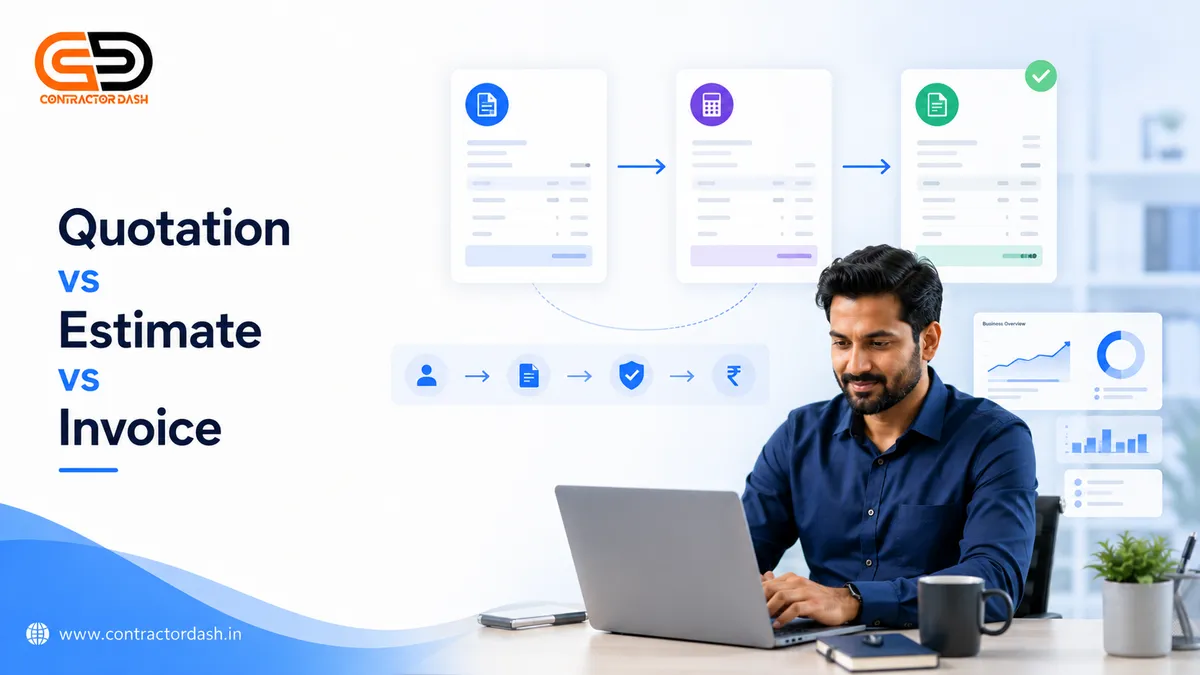
Most successful businesses follow a clear document flow:
- Customer sends an enquiry.
- Business prepares an Estimate (if costs are still approximate).
- Business sends a Quotation once pricing is finalized.
- Customer approves the quotation.
- Products or services are delivered.
- Business generates an Invoice.
- Customer completes payment.
Following this sequence creates a smoother sales process and reduces misunderstandings.
Why Growing Businesses Use Integrated Software
As enquiry volumes increase, managing estimates, quotations, and invoices through Word documents or spreadsheets can become difficult.
An integrated business management platform can help by allowing businesses to:
- Create estimates and quotations from one system.
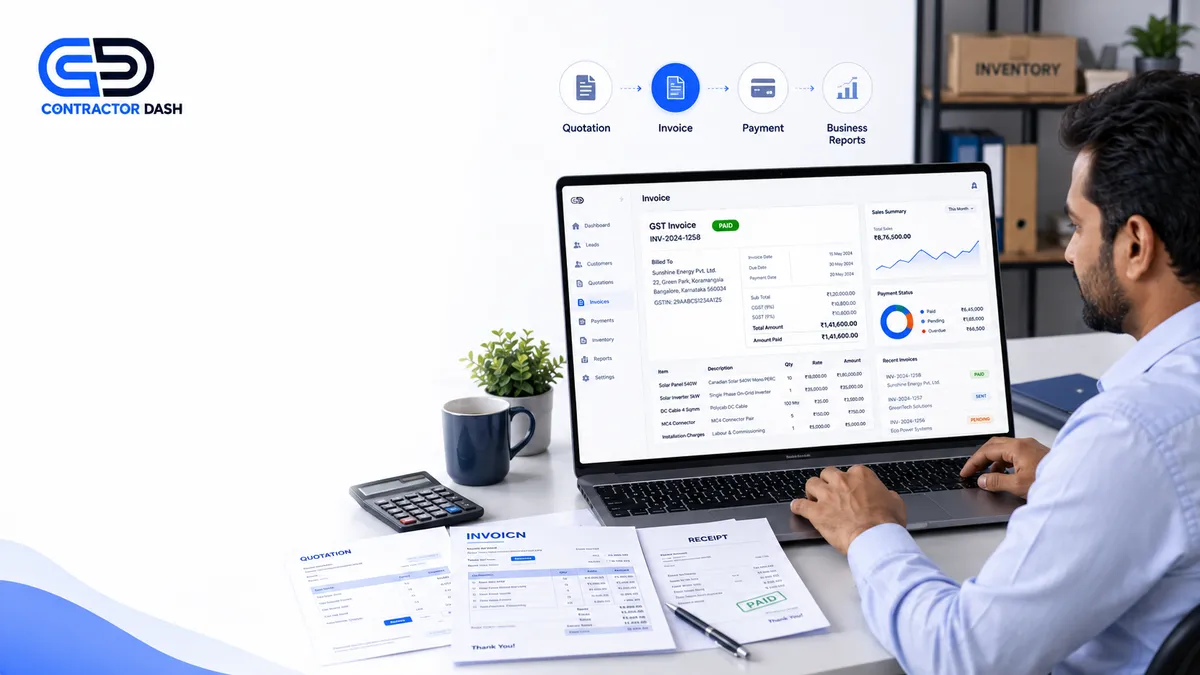
- Convert approved quotations into invoices.
- Store customer records centrally.
- Track document history.
- Calculate GST automatically.
- Monitor pending quotations and unpaid invoices.
- Generate business reports.
This reduces duplicate work and keeps the sales process organized.
Also Read this: Best Quotation Software for Small Businesses in India
Frequently Asked Questions
Can an estimate become a quotation?
Yes. Once project details are finalized, an estimate can be converted into a formal quotation with fixed pricing.
Can a quotation become an invoice?
Yes. After the customer approves the quotation and the work is completed or goods are delivered, it can be converted into an invoice.
Is a quotation legally binding?
A quotation itself is generally an offer. Once accepted and supported by agreed terms, it may become part of a contractual agreement depending on the circumstances and applicable law.
Should quotations include GST?
If your business is registered under GST and the transaction is taxable, it's good practice to clearly show the applicable GST on the quotation.
Can I use Excel for quotations and invoices?
Yes, but as your business grows, dedicated business management software can simplify document creation, improve tracking, and reduce manual errors.
Conclusion
Understanding the difference between quotations, estimates, and invoices helps businesses communicate clearly, avoid costly misunderstandings, and create a more professional sales process.
Think of them as three stages of the same customer journey:
- Estimate → Gives an approximate cost.
- Quotation → Confirms the agreed price.
- Invoice → Requests payment after delivery.
By using the right document at the right time, your business can improve customer confidence, reduce disputes, and maintain accurate financial records.
Ready to Simplify Your Sales Documents?
If your business manages multiple quotations, estimates, invoices, customer records, and follow-ups every day, using an integrated platform can save time and reduce manual work.
With ContractorDash, you can create professional quotations, manage customer information, convert approved quotations into invoices, track document status, and handle your business operations from a single dashboard.
Also Read this: Best Quotation Software for Small Businesses in India