
Introduction
Imagine this.
A customer contacts your business asking for a quotation.
You quickly prepare one in Microsoft Word, copy prices from an old Excel sheet, manually calculate GST, save it as a PDF, and send it through WhatsApp.
A few hours later, the customer replies:
"There seems to be a pricing mistake."
Now you need to reopen the document, recalculate the total, create another PDF, and send the revised quotation again.
By the time you finish, your competitor has already sent a professional quotation with branded formatting, accurate pricing, GST details, payment terms, and a clear validity period.
Who do you think the customer is more likely to trust?
For many Indian businesses, creating quotations is still a manual process. Sales teams rely on scattered Excel sheets, outdated templates, and repetitive copy-paste work. This not only wastes valuable time but also increases the risk of pricing errors, inconsistent branding, delayed responses, and lost sales opportunities.
A well-designed business quotation is much more than a price list. It is often the first formal document a potential customer receives from your business. A clear, accurate, and professional quotation builds confidence, demonstrates credibility, and increases the chances of converting enquiries into paying customers.
Whether you run a construction company, retail business, manufacturing unit, service agency, consultancy, wholesale business, or growing startup, having a structured quotation process can significantly improve your sales workflow and customer experience.
In this guide, you'll learn:
- What a business quotation is and why it matters
- The key elements every quotation should include
- Common mistakes businesses make while preparing quotations
- A step-by-step process to create professional quotations
- Best practices to improve quotation approval rates
- How modern quotation management software can simplify the entire process
By the end of this guide, you'll have a practical framework for creating quotations that are accurate, professional, and designed to help your business win more customers.
What Is a Business Quotation?
A business quotation is a formal document that outlines the products or services a business is offering to a customer along with the pricing, taxes, payment terms, delivery timelines, validity period, and other important conditions.
Unlike a casual price estimate shared over a phone call or WhatsApp, a quotation serves as an official proposal that clearly communicates the cost of doing business before any work begins.
Think of it as a written agreement that helps both the business and the customer stay aligned on expectations.
A standard business quotation typically includes:
- Company name and branding
- Customer information
- Quotation number
- Issue date
- Validity date
- List of products or services
- Quantity and unit price
- GST and tax details
- Discounts (if applicable)
- Total amount payable
- Terms and conditions
- Payment details
- Authorized signature
A professional quotation not only helps customers make informed decisions but also reduces misunderstandings, pricing disputes, and unnecessary revisions later in the sales process.
For businesses that generate multiple quotations every week, maintaining consistency and accuracy manually can become challenging. This is where a structured quotation management process and eventually quotation management software can make a significant difference.
Why Every Business Needs Professional Quotations
Many business owners believe a quotation is simply a document that lists products, prices, and taxes. In reality, it is one of the most powerful sales tools in your business.
Before a customer places an order, signs a contract, or transfers an advance payment, they usually review your quotation. This makes the quotation the first official representation of your professionalism, pricing transparency, and business credibility.
A professionally prepared quotation does much more than communicate costs. It builds trust, reduces confusion, answers common customer questions, and helps prospects make faster buying decisions.
For example, imagine two suppliers offering similar prices. One sends a plain WhatsApp message with a rough estimate, while the other provides a branded quotation with GST details, payment terms, delivery timelines, warranty information, and a clear validity period. Most customers will naturally feel more confident choosing the second supplier, even if the price is slightly higher.
A structured quotation process also benefits your internal operations. Your sales team spends less time answering repetitive questions, finance teams receive fewer billing disputes, and management can track quotation approvals, pending deals, and conversion rates more effectively.
In short, a professional quotation is not just a pricing document it is a sales document that directly influences revenue.
Difference Between Quotation, Estimate, Invoice, and Proposal
Many businesses use these terms interchangeably, but each document serves a different purpose. Understanding the differences helps maintain professionalism and prevents confusion during the sales process.
| Document | Purpose | Sent When | Includes Pricing? | Legally Binding? |
|---|---|---|---|---|
| Quotation | Confirms exact pricing for requested products or services | Before order confirmation | ✅ Yes | Generally accepted once approved |
| Estimate | Provides an approximate cost when final details are not available | Early discussion stage | ✅ Approximate | No |
| Proposal | Explains the complete solution, scope of work, methodology, and pricing | Complex projects or services | ✅ Usually | No |
| Invoice | Requests payment after goods are delivered or services are completed | After work completion | ✅ Final amount | Financial document |
Example
A construction company receives an enquiry for building a boundary wall.
The sales process may look like this:
- Customer requests pricing.
- Company provides an Estimate.
- After site inspection, the company prepares a detailed Quotation.
- If the customer approves, work begins.
- Once the project is completed, an Invoice is generated for payment.
Each document has a specific role, and using the correct one improves customer communication and reduces misunderstandings.
Why Businesses Lose Customers Because of Poor Quotations
Many businesses lose sales without realizing that the quotation—not the price—is the real reason.
Below are some of the most common mistakes that reduce customer confidence and delay decisions.
1. Slow Response Time
Customers often contact multiple vendors before making a purchase. If your quotation takes two or three days to prepare while a competitor responds within an hour, you may lose the opportunity before the customer even reviews your pricing.
Fast responses create a strong first impression and show that your business is organized and reliable.
2. Manual Calculation Errors
Preparing quotations manually in Excel or Word increases the chances of mistakes such as:
- Incorrect GST calculations
- Wrong quantities
- Pricing mismatches
- Missing discounts
- Incorrect totals
Even a small error can make customers question your professionalism and delay the buying process.
3. Poor Design and Formatting
A quotation filled with inconsistent fonts, misaligned tables, or cluttered information can appear unprofessional.
Customers often associate the quality of your documents with the quality of your work. A clean, branded quotation helps establish credibility.
4. Missing Important Information
Many quotations fail to include details such as:
- Validity period
- Payment terms
- Delivery timelines
- Warranty information
- Scope of work
- Terms and conditions
When these details are missing, customers usually ask additional questions, delaying the sales cycle.
5. No Follow-Up Process
Sending a quotation is only the beginning.
Many businesses never track whether the customer opened the quotation, requested changes, or approved it. Without a follow-up process, promising opportunities are often forgotten.
A systematic quotation management workflow ensures that every enquiry receives timely follow-ups until a final decision is made.
6. No Centralized Record
Businesses that manage quotations through email folders or WhatsApp chats often struggle to answer simple questions such as:
- How many quotations were sent this month?
- Which quotations are still pending?
- Which salesperson has the highest conversion rate?
- Which customers requested revisions?
- How many quotations were converted into invoices?
Without centralized records, analyzing sales performance becomes difficult.
Step-by-Step Guide to Creating a Professional Business Quotation
Creating a quotation should follow a structured workflow rather than being prepared from scratch every time.
Step 1: Collect Complete Customer Information
Before preparing the quotation, gather all relevant customer details, including:
- Customer name
- Company name
- Contact number
- Email address
- GST number (if applicable)
- Billing address
- Delivery location
Having complete information reduces errors and speeds up future communication.
Step 2: Clearly Understand Customer Requirements
Discuss the customer's expectations before preparing pricing.
Confirm details such as:
- Products or services required
- Quantities
- Specifications
- Delivery timeline
- Installation requirements
- Warranty expectations
- Payment preferences
The more accurately you understand the requirement, the more accurate your quotation will be.
Step 3: Calculate Costs Carefully
Your quotation should include all applicable costs, such as:
- Product cost
- Labour charges
- Transportation
- Installation
- Packaging
- GST
- Additional taxes
- Discounts
Avoid hiding charges that may surprise customers later.
Transparent pricing builds long-term trust.
Step 4: Use a Professional Quotation Format
Your quotation should include:
- Company logo
- Business details
- Customer details
- Quotation number
- Date
- Validity period
- Product table
- Pricing summary
- GST breakdown
- Payment terms
- Terms & Conditions
- Authorized signature
A standardized template ensures consistency across all quotations.
Step 5: Review Before Sending
Before sending the quotation, verify:
- Customer name spelling
- Product descriptions
- Quantity
- Unit prices
- GST calculation
- Total amount
- Contact information
- Payment details
- Validity date
A final review helps prevent costly mistakes and reflects professionalism.
Step 6: Send the Quotation Promptly
Once reviewed, send the quotation through the customer's preferred communication channel, such as email or WhatsApp.
Responding quickly increases the chances of converting enquiries into confirmed orders.
Step 7: Schedule a Follow-Up
Many customers need time to evaluate quotations or compare vendors.
Instead of waiting indefinitely, follow up politely after a reasonable interval to:
- Confirm receipt
- Answer questions
- Clarify pricing
- Offer additional information
- Encourage a decision
Consistent follow-ups often make the difference between a lost lead and a successful sale.
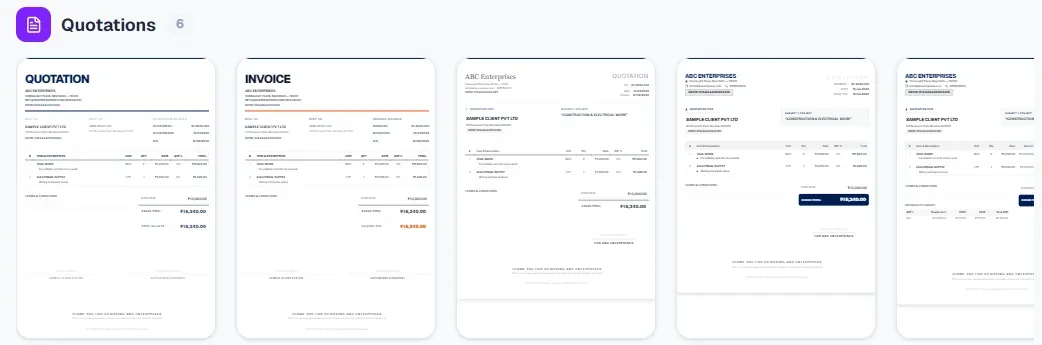
These are some of quotation temeplate exmaple of ContractorDash Software.
Quick Checklist Before Sending Any Quotation
Use this checklist to ensure every quotation is complete and professional:
- Company logo and branding included
- Customer information verified
- Unique quotation number assigned
- Accurate product or service descriptions
- Correct quantities and pricing
- GST and taxes calculated correctly
- Discounts clearly mentioned
- Validity period specified
- Payment terms included
- Delivery timeline mentioned
- Terms and conditions added
- Contact information updated
- Final proofreading completed
A simple checklist like this can significantly reduce errors and improve customer confidence.
Best Practices Used by Successful Businesses
Businesses that consistently win more projects don't just offer competitive pricing—they present quotations in a way that inspires confidence and makes decision-making easier for customers.
Here are some proven practices followed by successful businesses across industries.
1. Respond to Enquiries Quickly
In many industries, the first professionally prepared quotation often has a significant advantage.
Customers usually contact multiple vendors before making a decision. A business that sends a clear and accurate quotation within a few hours demonstrates responsiveness and professionalism.
Faster responses can improve customer experience and increase the likelihood of moving the conversation forward.
Expert Tip: Create reusable quotation templates so your team spends less time formatting documents and more time serving customers.
2. Keep Every Quotation Consistent
Imagine receiving two quotations from the same company with different logos, fonts, layouts, or payment terms. It creates confusion and reduces trust.
Maintain consistency by using a standardized quotation format that includes:
- Company branding
- Professional layout
- Standard terms and conditions
- Uniform pricing tables
- Clear GST summary
Consistency reinforces your brand and helps customers recognize your business.
3. Be Transparent About Pricing
Avoid hidden charges.
Customers appreciate quotations that clearly explain:
- Product price
- Service charges
- Transportation
- Installation
- GST
- Discounts
- Total payable amount
Transparent pricing reduces follow-up questions and builds long-term trust.
4. Add Value Instead of Only Reducing Price
When customers compare quotations, they don't always choose the cheapest option.
Instead of lowering your prices immediately, highlight the additional value you provide, such as:
- Faster delivery
- Better warranty
- Dedicated support
- Higher-quality materials
- Professional installation
- Ongoing maintenance
- After-sales service
A quotation that communicates value can justify premium pricing.
5. Follow Up Professionally
Many quotations remain pending simply because no one follows up.
A polite follow-up message after a few days can:
- Answer customer questions
- Resolve concerns
- Confirm pricing
- Increase conversion rates
Following up demonstrates commitment without appearing pushy.
Common Mistakes Businesses Make While Preparing Quotations
Even experienced businesses occasionally make avoidable mistakes.
Recognizing these issues can help improve both customer satisfaction and conversion rates.
❌ Using Old Pricing
Markets change frequently.
Using outdated price lists can result in financial losses or customer dissatisfaction.
❌ Copy-Pasting Previous Quotations
Reusing old quotations without careful review often leads to:
- Wrong customer names
- Incorrect product details
- Outdated terms
- Pricing mistakes
Always verify every quotation before sending it.
❌ Forgetting GST or Taxes
Incorrect tax calculations create confusion and may require revised quotations later.
Always verify applicable GST rates before finalizing the document.
❌ Sending Unbranded Documents
A plain Excel sheet with no company logo or business information appears less trustworthy than a professionally branded quotation.
Branding reinforces credibility.
❌ No Expiry Date
Without a validity period, customers may return months later expecting the same prices.
Clearly mention quotation validity to avoid pricing disputes.
❌ No Customer Tracking
Businesses often send quotations but fail to track:
- Pending approvals
- Customer feedback
- Revision requests
- Conversion status
Without tracking, valuable opportunities may be overlooked.
Manual Quotations vs Excel vs Quotation Management Software
Choosing the right method for creating quotations depends on your business size, quotation volume, and workflow requirements.
The comparison below highlights the differences.
| Feature | Manual Documents | Excel Sheets | Quotation Software |
|---|---|---|---|
| Professional Formatting | Limited | Moderate | Excellent |
| GST Calculation | Manual | Formula-Based | Automatic |
| Customer Database | ❌ | Limited | ✅ |
| Product Database | ❌ | Limited | ✅ |
| Revision Management | Difficult | Moderate | Easy |
| Approval Tracking | ❌ | ❌ | ✅ |
| Quotation History | Difficult | Moderate | Automatic |
| Convert to Invoice | ❌ | ❌ | ✅ |
| Team Collaboration | ❌ | Limited | ✅ |
| Reporting & Analytics | ❌ | ❌ | ✅ |
As businesses grow, manual methods often become time-consuming and difficult to manage. Dedicated quotation software can streamline repetitive tasks and provide better visibility into the sales process.
How ContractorDash Simplifies Quotation Management
As your business expands, managing quotations through Word documents, Excel spreadsheets, emails, and WhatsApp chats can become increasingly challenging.
A centralized workflow helps reduce manual effort and keeps your sales process organized.
ContractorDash is designed to support businesses by bringing quotation management into a single platform.
Instead of creating every quotation from scratch, your team can work with organized customer records, product catalogs, pricing information, and GST calculations in one place.
Some capabilities that can simplify quotation management include:
Create Professional Quotations Faster
Prepare quotations using standardized formats with customer details, pricing, GST, payment terms, and branding.
Customer Information in One Place
Access customer contact details and previous quotation history without searching through multiple files or messages.
Product and Pricing Management
Maintain a centralized product catalog to reduce repetitive data entry and improve pricing consistency.
GST-Ready Calculations
Automatically include applicable taxes and generate accurate totals, reducing manual calculation errors.
Convert Quotations into Invoices
Once a quotation is approved, continue the workflow by creating an invoice without re-entering the same information.
Track Quotation Status
Monitor whether quotations are:
- Draft
- Sent
- Pending
- Approved
- Rejected
- Converted into invoices
This helps sales teams prioritize follow-ups and understand the current sales pipeline.
Business Reports
View reports such as:
- Total quotations generated
- Approval rate
- Conversion rate
- Revenue from approved quotations
- Pending quotation value
- Sales team performance
These insights support better business decisions.
Industry Examples
Construction Company
A civil contractor receives multiple enquiries every week for residential and commercial projects.
Instead of preparing each quotation manually, standardized quotation workflows help maintain consistent pricing, GST calculations, and project details while making it easier to track revisions and approvals.
Manufacturing Business
Manufacturers often deal with hundreds of products and customized pricing.
Using organized product catalogs and quotation workflows helps reduce pricing errors and speeds up customer responses.
Retail Business
Retail businesses frequently prepare quotations for bulk purchases.
A structured quotation process allows staff to generate quotations quickly while maintaining accurate pricing and taxes.
Service Agency
Marketing agencies, IT companies, and consultancies can create quotations that clearly define the project scope, deliverables, timelines, and payment milestones.
This improves client communication and minimizes misunderstandings.
Professional Quotation Checklist
Before sending a quotation, confirm the following:
✔ Company branding is included.
✔ Customer information is accurate.
✔ Products or services are correctly listed.
✔ Quantities are verified.
✔ Prices are accurate.
✔ GST calculations are correct.
✔ Discounts are clearly mentioned.
✔ Payment terms are defined.
✔ Validity period is included.
✔ Delivery timeline is specified.
✔ Terms and conditions are attached.
✔ Contact details are updated.
✔ The document has been proofread.
A simple review process like this helps maintain consistency and reduces the likelihood of avoidable revisions.
Key Takeaways
- A professional quotation is more than a pricing document—it reflects your business credibility.
- Standardized quotation formats improve consistency and customer confidence.
- Transparent pricing and timely follow-ups can increase conversion opportunities.
- Manual processes become harder to manage as quotation volume grows.
- A centralized quotation management system can simplify workflows, reduce errors, and support better sales tracking.
Frequently Asked Questions (FAQs)
1. What is a business quotation?
A business quotation is a formal document that provides the exact price of products or services requested by a customer. It usually includes product details, quantities, GST, payment terms, delivery timelines, validity period, and other important conditions before a customer confirms an order.
2. What should be included in a professional quotation?
A professional quotation should include:
- Company name and logo
- Customer details
- Unique quotation number
- Date of issue
- Validity period
- Product or service description
- Quantity
- Unit price
- GST or tax details
- Discounts (if applicable)
- Total payable amount
- Payment terms
- Delivery timeline
- Terms and conditions
- Authorized signature
3. What is the difference between a quotation and an invoice?
A quotation is sent before a customer confirms an order and outlines the proposed pricing and terms. An invoice is generated after goods are delivered or services are completed and serves as a request for payment.
4. What is the difference between a quotation and an estimate?
An estimate provides an approximate cost when the final scope is not fully known, while a quotation usually offers fixed pricing for a defined set of products or services.
5. How long should a quotation remain valid?
The validity period depends on your industry and price fluctuations. Many businesses use a validity period of 7 to 30 days to protect themselves from changing material costs or market prices.
6. Can a quotation be edited after it is sent?
Yes. If the customer requests changes or project requirements change, you can issue a revised quotation. It's good practice to maintain version history to avoid confusion.
7. Is GST mandatory on quotations in India?
If your business is registered under GST and the transaction attracts GST, your quotation should clearly mention the applicable GST rates and tax amounts. Consult your tax advisor if you're unsure about specific requirements.
8. Should I include payment terms in a quotation?
Yes. Mentioning payment terms—such as advance payment, milestone payments, or payment due on delivery—helps avoid misunderstandings and sets clear expectations.
9. What are the most common quotation mistakes?
Common mistakes include:
- Incorrect pricing
- GST calculation errors
- Missing validity period
- Poor formatting
- Outdated product information
- No payment terms
- Copy-paste errors
- Sending quotations late
- Not following up with customers
10. How can I make my quotation look more professional?
Use a branded layout, organize information into clear sections, provide accurate pricing, include terms and conditions, and proofread before sending. A consistent template also improves professionalism.
11. Should quotations have a unique number?
Yes. Assigning a unique quotation number makes it easier to track documents, communicate with customers, and maintain records for future reference.
12. Can I create quotations in Excel?
Yes. Excel can be suitable for businesses with a low quotation volume. However, as operations grow, managing quotations manually may become more time-consuming and increase the risk of errors.
13. When should a business consider quotation management software?
Businesses that prepare multiple quotations each week, manage large product catalogs, or require approval tracking and reporting may benefit from a dedicated quotation management system.
14. Can a quotation be converted into an invoice?
Yes. Many modern business management systems allow approved quotations to be converted into invoices, reducing duplicate data entry and helping maintain accuracy.
15. Which businesses benefit most from quotation management software?
Quotation management software can be useful for:
- Construction companies
- Civil contractors
- Interior designers
- Manufacturers
- Retailers
- Wholesalers
- Distributors
- Marketing agencies
- IT service providers
- Consultants
- Solar businesses
- Fabricators
- Furniture manufacturers
- Engineering companies
- Service-based businesses
Final Thoughts
A professional quotation is often the first formal interaction a customer has with your business. It communicates not only your pricing but also your professionalism, attention to detail, and commitment to delivering quality service.
Businesses that rely on outdated templates, manual calculations, or scattered spreadsheets often face avoidable challenges such as pricing errors, inconsistent branding, delayed responses, and limited visibility into their sales pipeline.
By adopting a structured quotation process whether through standardized templates or dedicated quotation management software you can improve consistency, reduce manual work, respond to enquiries faster, and create a smoother experience for both your team and your customers.
Improving your quotation process isn't just about preparing better documents. It's about building trust, increasing efficiency, and creating a stronger foundation for long-term business growth.
If your team spends too much time creating quotations manually or struggles to keep track of customer enquiries, it may be worth exploring a more centralized workflow.
ContractorDash brings quotation management together with CRM, customer records, invoicing, inventory, project management, and business reporting in a single platform. Instead of juggling multiple spreadsheets and documents, businesses can manage the entire sales process from one dashboard.
If you'd like to see how a centralized quotation workflow could fit your business, consider requesting a personalized demo to explore the platform's features and determine whether it meets your operational needs.