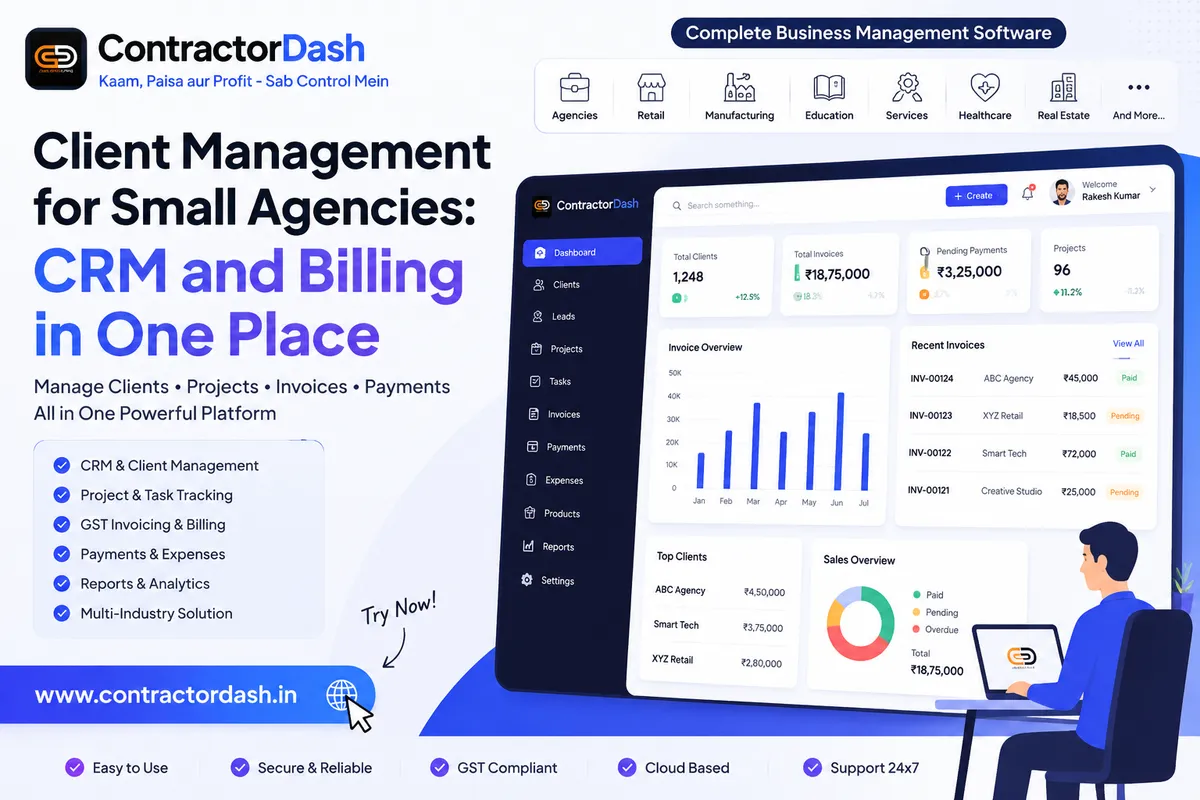
Client Management for Small Agencies: CRM and Billing in One Place
Most small agencies in India did not set out to run five different tools just to manage one client relationship. It happens gradually. Leads come in through Instagram DMs and WhatsApp. Proposals get sent as PDF attachments through email. Invoices get created in a separate billing app or a spreadsheet template someone found online three years ago. Follow ups live inside your memory, or worse, inside a notes app you forget to check.
This is the quiet reason so many small agencies plateau instead of growing. It is rarely a talent problem. It is a systems problem. When client information, communication history, and billing all live in different places, things slip through the cracks, and clients notice.
The Real Cost of Scattered Client Management
Ask any agency owner what actually causes client churn and very few will say quality of work. The more common answers sound like this:
- A follow up got missed because it was buried in a WhatsApp chat from two weeks ago
- An invoice went out late because nobody remembered the project had wrapped
- A lead went cold because three team members thought someone else was handling it
- A client asked for a payment history and it took an hour to piece together from three different tools
None of these are talent problems. They are visibility problems, and they are entirely fixable with a system that connects client relationships to the money side of the business.
Why CRM and Billing Should Never Be Separate Tools
Many agencies use a CRM for leads and a completely separate app for invoicing. On paper this seems fine, but in practice it creates a disconnect at the exact moment it matters most: when a lead becomes a paying client.
Think about the actual lifecycle of a client at a small agency:
- A lead comes in through a form, referral, or social media inquiry
- You have a discovery call and note down requirements
- You send a quotation or proposal
- The client approves and work begins
- You raise an invoice, often in milestones
- You follow up on payment
- The relationship either ends or becomes a recurring retainer
When steps one through three happen in a CRM and steps four through seven happen in separate billing software, someone on your team has to manually copy client details, project scope, and pricing between two systems every single time. That manual step is where errors, delays, and missed follow ups quietly creep in.
What a Connected CRM and Billing System Actually Looks Like
One Client Record, Not Five
Every interaction, from the first inquiry to the last invoice, should sit under one client profile. When you open a client record, you should immediately see their contact history, active proposals, past invoices, and outstanding payments without switching tabs or apps.
Leads That Do Not Get Forgotten
A proper pipeline view shows exactly where every lead stands, whether they are at the inquiry stage, proposal stage, or negotiation stage. Instead of relying on memory, the system reminds you and your team when a follow up is due.
In ContractorDash, this is handled through the Leads and Pipeline views, with automated follow up reminders so no inquiry sits untouched for weeks.
Quotations That Convert Directly to Invoices
Once a client approves a proposal, that same document should become the invoice, carrying over the scope, pricing, and terms automatically. There is no reason to retype pricing details a second time, and every retyping is a chance for a mismatch that confuses the client later.
Retainers and Recurring Billing Without Manual Reminders
Agencies commonly work on monthly retainers. Instead of manually raising the same invoice every month, recurring billing automates it, so payment requests go out on schedule without anyone needing to remember.
Payment Visibility Without Chasing Spreadsheets
An owner should be able to open one screen and immediately see which clients have paid, which are overdue, and by how many days. This single view often reveals cash flow issues weeks before they would otherwise be noticed.
How This Helps Agencies Actually Grow
When client management and billing sit in one place, three things improve almost immediately.
Response time improves. New inquiries get answered faster because they are visible in one dashboard instead of scattered across inboxes and chat apps.
Cash flow becomes predictable. Because invoices and follow ups are automated, payment delays shrink, and owners stop discovering unpaid invoices by accident months later.
Client experience feels more professional. Clients notice when a proposal turns cleanly into an invoice, when follow ups are timely, and when payment history is available instantly. This builds the kind of trust that leads to referrals and retainer renewals.
A Simple Framework to Get Started
If your agency is still managing clients across scattered tools, here is a practical way to transition:
- List every tool currently used for leads, proposals, and billing
- Identify which client information lives only in someone's head or a personal chat, and get it into a shared system
- Move new leads into a single pipeline view starting this week, even if old data stays where it is for now
- Set up recurring invoices for any client on a retainer so nothing depends on someone remembering
- Review your outstanding payments list weekly instead of only when cash feels tight
How Agencies Use ContractorDash for This
ContractorDash brings CRM and billing together specifically so small agencies and freelance practices are not stitching together separate tools:
- CRM Dashboard for a full view of leads, pipeline stage, and client history
- Lead Form Builder to capture inquiries directly from your website or social channels
- Quotations that convert directly into Invoices
- Recurring Invoices for retainer clients
- Outstanding Report to see unpaid invoices at a glance
- CRM Reports to understand which lead sources actually convert
Final Thoughts
Small agencies rarely lose clients because of the quality of their work. They lose clients because follow ups get missed, invoices go out late, and information lives in too many places for anyone to keep track of consistently. Bringing CRM and billing into one connected system removes that friction entirely, and it is often the single biggest operational change that lets a small agency grow past its founder's personal memory and attention span.
Want to see how this would work for your agency? Contact our team for a quick walkthrough, or start a free trial directly.